How to Run an Automated Trade-In Program for Retailers (Without Building It from Scratch)

Cullin McGrath
Chief Executive Officer
Right now, somewhere in your back office, there's a spreadsheet slowly eating your trade-in program alive.
The trade-in economy is real, and it's growing faster than most retailers expected. The US recommerce market exceeded $200 billion in 2024 — up from $140 billion in 2020 — and it's on track to hit $306 billion by 2030. (DontPayFull, citing OfferUp/GlobalData, 2026) That's not a niche trend. That's a structural shift in how consumers relate to the things they own. The signal for retailers is hard to miss: 47% of consumers say they're more likely to make a first-time purchase from a brand that offers trade-in credit — up 25 percentage points from 2023. (ThredUp 2025 Resale Report, via DontPayFull)
The demand is there. The execution is the problem.
Most retailers who've tried running a trade-in program end up with the same patchwork: one spreadsheet for valuations, a separate email thread for shipping, and a manual payout queue that gets processed whenever someone has bandwidth. Items disappear between handoffs. Quotes go stale. Customers wait two weeks, hear nothing, and give up. The program that was supposed to build loyalty ends up generating complaints — and eventually gets shut down because the headache outweighs the return.
This guide is for retailers who are ready to run a real trade-in program. Not a pilot that dies after three months, but a scalable operation that drives new purchases, repeat business, and customer lifetime value. We'll cover where manual programs break down, what an automated trade-in system actually does operationally, and what to look for when choosing a platform that handles pricing, logistics, and payouts without requiring you to build anything from scratch.
Why Trade-In Programs Are No Longer Optional
Retailers who still treat trade-in programs as a "nice to have" are making a bet the data doesn't support.
94% of retail executives say their customers already participate in resale — an all-time high. (ThredUp 2025 Resale Report, via DontPayFull) Those customers aren't waiting for you. They're trading in on Facebook Marketplace, through brand-direct programs, or at competing retailers who got there first. The question isn't whether your customers want to trade in — it's whether they're doing it with you or without you.
The competitive pressure compounds this. Branded resale programs tripled from 2020 to 2021, and mid-market chains have kept pace since. (DontPayFull, 2026) Competitors you might not have considered direct threats — specialty chains, DTC brands, independent retailers in adjacent categories — are now offering trade-in credit toward the next purchase. When a customer has $80 in credit sitting at a competitor's store, you don't just lose the trade-in. You lose the next transaction too.
The math on loyalty is straightforward. IKEA's buy-back program gives customers a 15% bonus when they take store credit over cash, engineering a near-certain repeat purchase. Decathlon found that customers who traded in old equipment bought again more often than those who didn't — the trade-in opened the next purchase cycle rather than closing the current one. These aren't isolated examples. They're the operating logic of retailers who figured out that recommerce isn't a sustainability initiative; it's a growth engine. Platforms like Reusely were built so that independent and mid-market retailers can run the same kind of program — without the enterprise budget or the internal engineering team to build it.
There's also the acquisition side of this. 47% of consumers are more likely to make a first-time purchase from a brand that offers trade-in credit. (ThredUp 2025 Resale Report, via DontPayFull) A trade-in program doesn't just keep existing customers coming back. It gives new customers — ones sitting on used gear with no obvious home for it — a concrete reason to try you first.
Where Manual Trade-In Programs Break Down
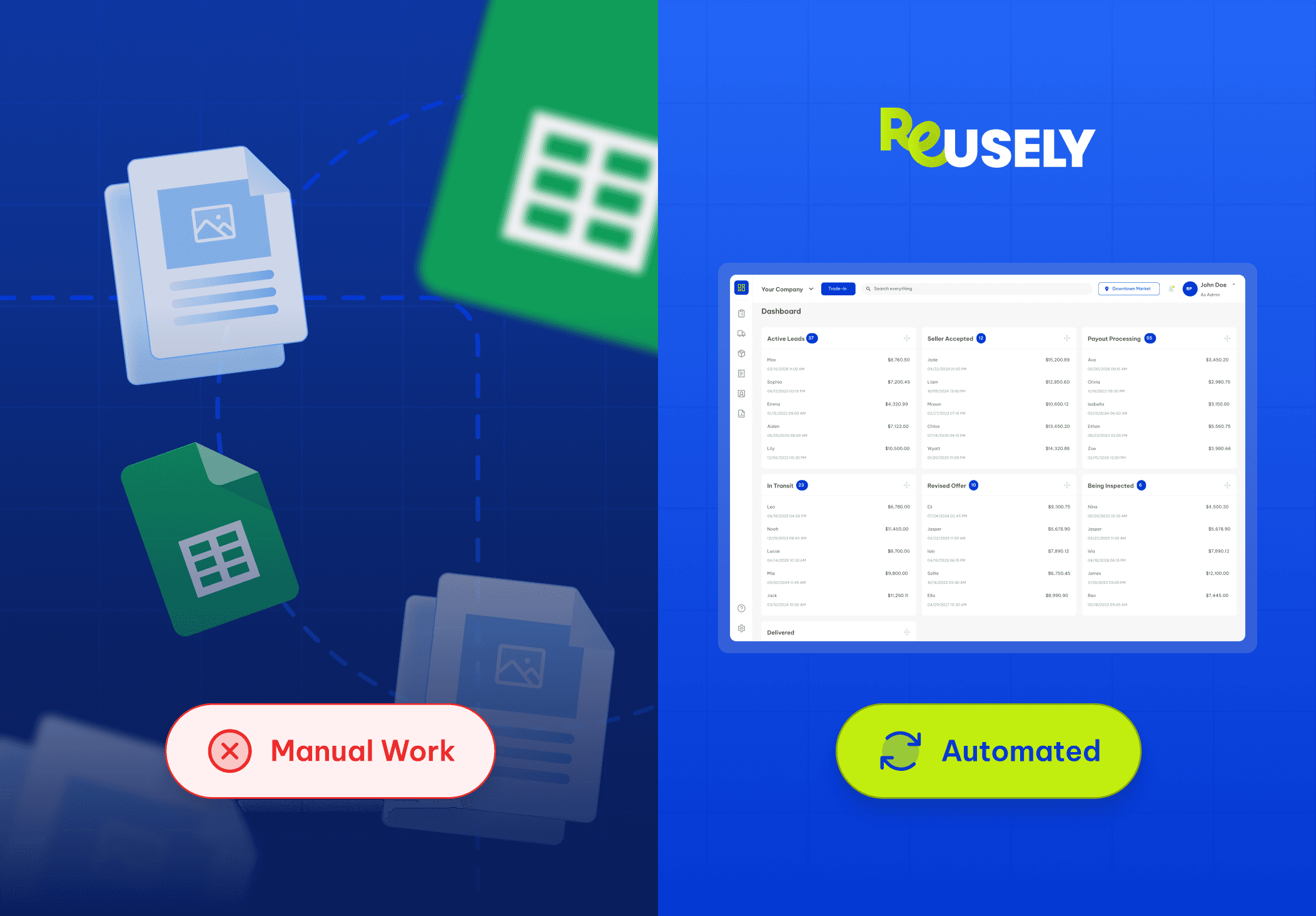
Retailers who've tried running a trade-in program manually tend to remember the specific moment it stopped working. It's always some version of the same four problems.
The Grading Problem
Manual grading is inconsistent by design. The value of a trade-in item depends on who's working the shift, how recently the rubric was updated, and how that person interprets terms like "good" versus "fair." Two staff members in the same store quote different amounts for the same item in the same condition.
That inconsistency compounds downstream. A customer gets a quote at intake, then a lower offer after the item reaches the processing center. Ingram Micro Lifecycle's analysis of trade-in program pitfalls is direct about what this does to customer trust: "Don't quote high and then try to lower the offer later on. Nobody likes a bait and switch." (Ingram Micro Lifecycle) It's the fastest way to make sure a customer never participates again — and tells others why.
The Payout Delay Problem
Slow payouts kill programs. Ingram Micro Lifecycle puts it plainly: "Keep the time between the transaction beginning and the customer receiving their money as short as possible." (Ingram Micro Lifecycle) That's not aspirational guidance — it's damage control for the most common failure mode.
In a manual program, payout processing means a person, a spreadsheet, and a queue with no defined SLA. There's no automated trigger when a trade-in clears inspection. There's no system notification to the customer. The AP team cuts a check when they get to it. A program that handles five trade-ins a week can limp along like this. At fifty, it collapses.
The Lost-Item Problem
Every trade-in moves through multiple hands: store intake, packaging, shipping, receiving, inspection, inventory entry, resale prep. In a manual system, each step is tracked separately — or not tracked at all. The handoff from store to shipping lives in an email. The handoff from shipping to warehouse lives in a packing slip that may or may not get scanned.
When a customer asks about their item two weeks later, no one has a complete view. The store says it shipped. The warehouse has no receiving record. The customer has no tracking number. This isn't an edge case; it's what happens when a process designed for low volume gets pushed harder than it was built for.
The Scale Problem
At low volume, manual programs function because the person running them can hold the state in their head. At higher volume, that person becomes the bottleneck — reconciling discrepancies, chasing shipping updates, fielding customer questions, and processing payouts all at once. The program doesn't fail because demand dries up. It fails because the infrastructure can't keep up with the demand that's there.
That's when most retailers either kill the program or acknowledge it needs a real system underneath it.
Key insight: 47% of consumers are more likely to make a first-time purchase from a brand that offers trade-in credit — but that lift only materializes if the program is reliable enough to trust. A manual program that mis-quotes, delays payouts, or loses items doesn't just fail to capture this opportunity. It turns interested customers into skeptical ones.

What an Automated Trade-In Program Actually Does
"Automated" gets used loosely. In trade-in programs, it means something specific: the pricing, logistics, inventory tracking, and payout functions run through a connected system, not through people moving data between tools manually.
Here's what each layer handles.
Automated Pricing Engine
A rules-based pricing engine values trade-in items against product category, condition, and market parameters — the same way, every time, without relying on staff judgment. A customer submits a trade-in, describes the item's condition, and gets an offer in real time. No 48-hour wait for a staff member to research the item and run a manual calculation.
The value here isn't just speed — it's consistency. When every customer submitting the same item in the same condition gets the same offer, there's nothing to dispute. Reusely's pricing engine works this way: a retailer configures the pricing rules once, and every incoming trade-in request is evaluated against those rules automatically, with no manual review step between the customer and the quote.
Integrated Logistics
Manual shipping coordination takes at least three steps: generate a label, get it to the customer, then track whether the item arrived. These steps happen across different tools, handled by different people, with no single system holding the full picture.
An integrated logistics layer generates prepaid labels automatically, delivers them without manual intervention, and maintains real-time tracking visible to both the retailer and the customer. Items don't go missing between handoffs because the system has a record at every stage. If a package is delayed, the system flags it before the customer has to follow up.
Inventory Tracking
From the moment a trade-in enters the pipeline, it has a status: received, in inspection, processing, resale-ready. That status is visible across teams — intake staff, processing, customer service — without anyone needing to call someone else to find out where an item is.
This doesn't solve the lost-item problem reactively, after items go missing. It removes the conditions that let items go missing in the first place.
Payout Management
Automated payout management ties settlement to an event — trade-in clears inspection — not to a person remembering to process a queue. Whether the customer chose store credit, a gift card, or direct payment, the payout runs on a defined schedule.
Beyond trust, this has operational value. Payout disputes are a persistent drain on customer service resources in manual programs. When payouts run automatically and customers receive a confirmation, the volume of disputes drops. The problem self-corrects.
What to Look for in a Plug-and-Play Trade-In Platform
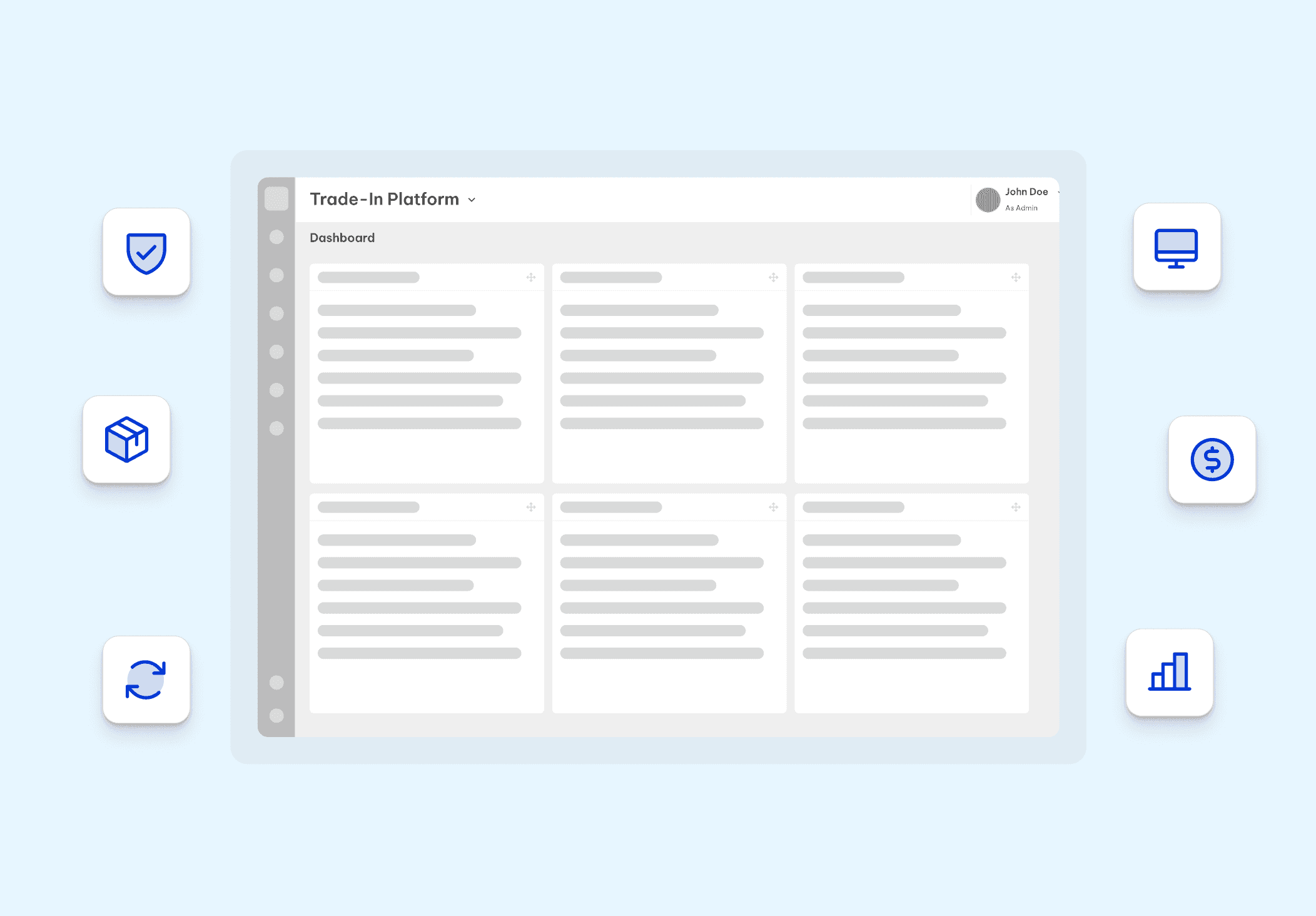
Most retailers don't need to build a custom trade-in system. The infrastructure already exists — the decision is which platform to run it on, and what matters when evaluating options.
These are the criteria that separate a platform that can genuinely replace a manual program from one that just adds another tool to manage.
Multi-category support: If your inventory spans electronics, sporting goods, appliances, or tools, your platform needs to handle all of it in one catalog. Single-category platforms force you to run parallel systems as the program grows.
Real-time pricing: Offers need to generate when the customer submits the request. A platform that queues offers for manual review brings back exactly the bottleneck you're trying to eliminate.
Built-in logistics: Shipping and tracking should live inside the platform. An external logistics integration means another connection to maintain and another system that can fall out of sync with your trade-in data.
Full audit trail: Every offer, every status change, every payout should be logged automatically. This matters for disputes, and it gives you the data to improve pricing and operations over time.
Payout flexibility: Customers want different payout types. A platform limited to one — store credit only, or cash only — narrows who participates. Look for store credit, gift cards, and direct payment in the same workflow.
Scalability without headcount: The platform should absorb volume growth without requiring proportionally more people to run it. If double the trade-in volume means double the administrative work, the automation isn't doing its job.
Reusely covers all six — pricing engine, built-in logistics, full inventory tracking, and flexible payouts in a single platform — which is why retailers use it instead of stitching together multiple tools or building their own infrastructure.
The Revenue Case for Getting This Right
A well-run trade-in program pays for itself in ways that don't show up in the trade-in transaction itself.
The acquisition effect is direct. Consumers who know a brand accepts trade-ins have a lower barrier to switching. That 47% first-purchase lift is an acquisition metric, not just a loyalty metric. A trade-in program that's well-publicized and demonstrably reliable gives undecided customers a concrete reason to try you first.
The repeat-purchase effect layers on top of it. Customers who trade in and receive store credit are already primed to spend — the credit creates a purchase trigger that customers who never engaged with the program simply don't have. That's the mechanism behind IKEA's bonus credit structure and Decathlon's repeat-purchase data. The trade-in doesn't close the customer relationship. It opens the next transaction.
And then there's what you protect: the customers who would have gone to a competitor with a functioning trade-in program. Recommerce is growing 5 to 6 times faster than traditional retail, and that's been true for five consecutive years now. (DontPayFull, 2026) The market moves with or without your participation. Retailers who build a reliable program now build an operational workflow and a customer habit. Those who wait will spend more to close the same gap later.
There's a softer operational return too. Every hour your staff spends reconciling spreadsheets, chasing shipping updates, or manually processing payout queues is an hour that isn't going toward customers, toward the floor, or toward growth. Automation doesn't replace human judgment. It replaces the tasks a system can do more accurately and more consistently than a person working from a spreadsheet.
Running a Trade-In Program That Actually Works
The retailers running great trade-in programs aren't necessarily bigger or better-funded than those who aren't. They made a different choice: they built a system instead of a process.
Manual trade-in programs don't fail because retailers don't care. They fail because coordinating pricing, logistics, inventory, and payouts across disconnected tools is too fragile to hold together at scale. Customers feel that fragility — in quotes that change at processing, in payouts that take three weeks, in items that no one can locate — and it costs you their trust faster than the program can earn it back.
The infrastructure to do this well exists. It doesn't require building anything from scratch. If you're evaluating trade-in platforms, Reusely offers a free trial where you can see how the pricing engine, logistics, and payouts work together before committing to a launch. That's the right place to start.






" width="1304.414px"/></svg>)