How to Increase Retail Customer Retention with Buyback Programs

Cullin McGrath
Chief Executive Officer
Most retailers are running the same retention playbook they ran five years ago. Points programs that customers forget to check. Promotional emails that get deleted. Seasonal discounts that train buyers to wait for the next sale. And all of it competing for inbox attention that keeps getting harder to earn.
That is not a creative failure. It is a mechanical one. When the mechanism is broken, trying harder with the same tools just accelerates the burn rate on your list.
A buyback program works differently. The moment a customer hands in their old product and receives a payout, they have completed a real transaction with your store rather than with a third-party marketplace. That exchange ties them to your brand at the exact moment they are thinking about what to buy next. It does not depend on inbox opens or loyalty app downloads. It is structural gravity.
Reusely is a trade-in and buyback platform built for retailers who want to run this kind of program without building the infrastructure from scratch, handling pricing, logistics, and payouts as one connected system rather than five separate tools. This guide explains why the buyback mechanism works, how to design one that compounds over time, and what the operational picture looks like for a mid-market retailer.
The Loyalty Program That Actually Retains
The average company loses between 10% and 25% of its customer base every year (Zippia, 2024). Most of that churn is quiet. Customers do not leave angry. They simply stop finding a reason to come back.
Points programs were supposed to fix this. In practice, they create a parallel motivation — collecting points — that runs alongside purchase intent rather than driving it. When a customer wants a new vacuum or a camera, the points balance is not what crosses their mind. Price, availability, and trust come first. Points come after, if at all.
A buyback program arrives earlier in that sequence. It gives customers a piece of real value tied specifically to your store before they start shopping. That structural pull is what separates a buyback program from a marketing program. One asks customers to remember you. The other gives them a financial reason to return.
Why Retention Math Beats Acquisition Math Right Now
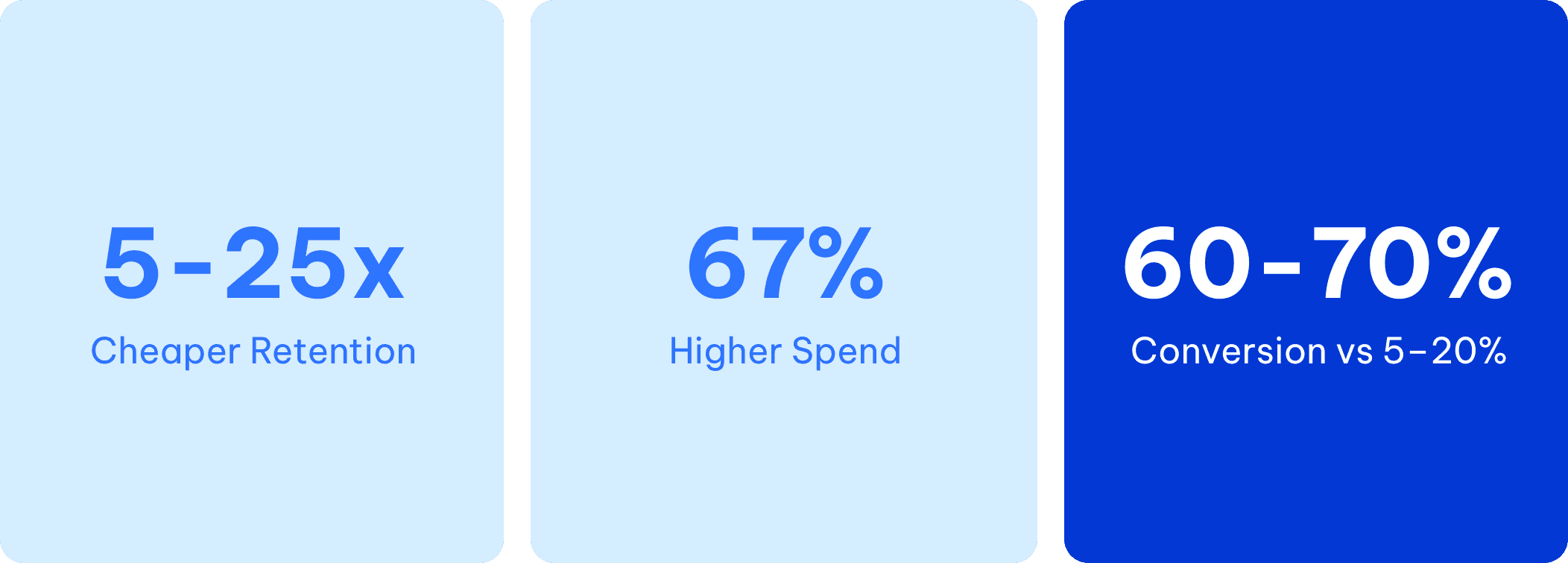
Retaining an existing customer costs approximately 5 to 25 times less than acquiring a new one (Harvard Business Review, 2014). That range has been documented for years and keeps widening. CPMs on paid channels have gone up. Attribution has deteriorated since iOS 14 and the ongoing deprecation of third-party cookies. Paid social is less efficient than it was three years ago. Every point of customer lifetime value you extract from your existing base is now worth more than a new customer you had to pay to acquire.
The Bain and Company research from Frederick Reichheld is foundational here: a 5% increase in customer retention rates can increase profits by 25 to 95%. The math is straightforward. Existing customers have already absorbed the acquisition cost. Revenue from them runs at a structurally higher margin from the first repeat purchase.
Existing customers spend on average 67% more than first-time buyers (Manta and BIA/Kelsey). The probability of closing a sale with an existing customer is 60 to 70%, versus 5 to 20% for a new prospect (Paul Farris, Marketing Metrics).
Most retailers know these numbers. Fewer have a mechanism that actually moves them in the right direction. That is the gap a buyback program fills.
The Upgrade Cycle: What a Buyback Program Actually Triggers
A buyback program is not primarily about the old product. The old product is just the trigger. What the program activates is three behavioral mechanisms running in parallel, each pulling the customer toward a repeat purchase.
Endowed Progress and the Trade-In Head Start
When a customer completes a trade-in, they have already done something. They showed up. They handed something over. The endowed progress effect, documented by Nunes and Drèze in the Journal of Consumer Research (2006), shows that people accelerate effort toward a goal the moment they perceive they have already begun. In the foundational study, customers with two pre-stamped loyalty card slots completed the program at a 34% rate. Those who started from zero completed it at 19%. Same number of purchases required. Different starting point.
A customer who just traded in a product is not starting from zero on their next purchase decision. They came in with an old product. They are leaving with a transaction already underway with your brand.
Loss Aversion and the Completion Window
A customer who just received a trade-in payout is already in-purchase mode. That window is short. The behavioral pressure to act on it while still in the store — or to return quickly before the moment passes — is real. Customers who complete a trade-in and leave without buying something have a specific, concrete reason to come back: they are mid-cycle.
Reusely's Automated Pricing Engine generates consistent, rules-based offers so customers know the number they received is reliable. That consistency is what turns a one-time trade-in into a repeatable behavior.
Mental Accounting and "House Money"
The behavioral economist Richard Thaler documented this in his foundational 1985 paper in Marketing Science: once money is reclassified as a specific type of value, people spend it differently than they spend general cash. A customer who just converted an old product into a payout is primed to spend it on the upgrade that prompted the trade-in. They came in to get rid of something old. They are mentally halfway through acquiring something new.
Each trade-in drives a return visit with above-baseline purchase intent. The customer is already in the buying mindset before they start browsing.
Designing a Buyback Program That Compounds
The behavioral mechanics only work if the program design activates them. Most buyback programs that fail do not fail because customers do not want them. They fail because the design killed the loop before it could run.
Payout Structure
The payout structure you choose shapes whether customers return. The framework:
Default to the payout type your platform supports. The retention value comes from closing the loop fast and reliably, not from the specific form of payout.
Speed matters more than amount. A customer who receives a fair payout immediately is more likely to return than one who receives a slightly higher payout after a week-long review process.
Make the offer transparent at intake. Whatever you pay, the customer should know the number before they hand anything over. Surprises at completion destroy trust faster than any other failure mode.
Expiration Windows
Too short (under 30 days) feels punitive. Too long (over 120 days) loses urgency. The 60 to 90 day window is where most retailers find the sweet spot. It aligns with typical repurchase cycles, gives customers enough runway to plan a meaningful purchase, and keeps enough expiration pressure to drive the return visit. Retailers with strong seasonal patterns can align expirations to push traffic into peak periods.
Pricing Transparency at Intake
The fastest way to destroy a buyback program is to quote a high number at intake and deliver a lower number after inspection. Customers remember the first figure. When the final offer comes in below what they were told, it registers as bait-and-switch regardless of whether the reduction is justified.
Rules-based automated pricing solves this cleanly. When the offer comes from a consistent grading rubric applied at intake, the number does not change. The customer gets the same offer whether the item was processed by a senior staff member or a new hire, on a Tuesday or a Saturday. That consistency is what makes customers trust the program enough to come back and do it again.
Key insight: Trade-in programs with transparent, consistent pricing and a 60 to 90 day completion window drive repeat purchase rates that points programs cannot match, because the trade-in creates structural return intent rather than aspirational return intent.
Where Buyback Programs Break (and Why Most Retailers Quit)
Four failure modes account for most buyback program shutdowns.
Slow payouts. If a customer trades in a product and waits a week for payment to process, the behavioral window closes. The return visit happens right after the trade-in, while the customer still feels in-purchase-mode. A week later that window is gone. Payout speed is a retention mechanism, not a logistics detail.
Inconsistent pricing. Manual grading by different staff members produces different offers for the same product in the same condition. Customers talk. When one person gets $80 and another gets $55 for identical items, the program gets a reputation for arbitrariness. That reputation is very hard to recover.
No attribution tracking. Without data showing which buyback participants went on to make a repeat purchase, there is no case to make to the CFO when the program comes up in a budget review. Programs that cannot prove their own ROI get cut, even when they are working.
Operational sprawl. Running pricing in one system, label generation in another, and payouts manually through a third creates failure points at every handoff. The customer experience degrades at each seam. Staff time gets consumed by exceptions and corrections. The program becomes a liability.
None of these are personnel failures. The fix is infrastructure.
What Running This Looks Like Without a Dev Team
The retailers running buyback programs profitably are not staffing a recommerce department. They are running on platforms that handle pricing, logistics, inventory, and payouts as a single connected flow.
Reusely is built for exactly this. The Automated Pricing Engine generates consistent offers from configurable grading rules. Logistics and Label Generation handles physical intake, whether online, in-store, or by mail, without requiring separate shipping contracts. The Payout and Completion Flow issues payment through the same system that generated the intake offer, so the number the customer sees at the start is the number they receive at the end. Over 300 businesses have built their trade-in programs on Reusely, and the platform has processed more than $15M in trade-in value.
This is not enterprise infrastructure adapted for smaller retailers. It was built specifically for retailers who want to launch a buyback program without hiring engineers or stitching together five separate vendors.
Build the Upgrade Cycle Before Your Competitor Does
The retailer who installs a buyback program first in their category trains customers to upgrade with them. Each trade-in tightens the loop. Customers bring products back, receive a payout, and return to buy something new. The next time they are ready to upgrade, they already know where to go. That is where their last transaction was.
The retailer who waits trains customers to go somewhere else. The upgrade cycle still runs. It just does not run through their store.
If you want to see what running a buyback program looks like on Reusely, start here.




" width="1304.414px"/></svg>)